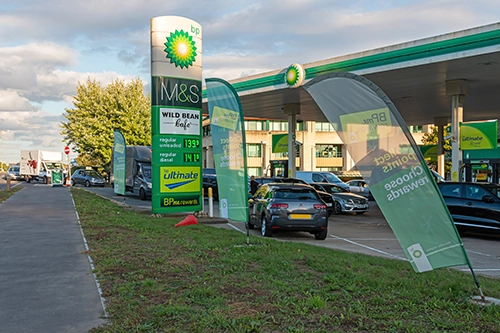

The government has contingency plans in place for petrol and diesel rationing that could be activated if the Middle East crisis continues to disrupt supplies. A Treasury minister this week refused to rule out the prospect of fuel rationing amid the ongoing conflict.
Here’s what we know about how rationing would work, who would get priority access, and what it would mean for everyday drivers.
The National Emergency Plan for Fuel
The Department for Energy Security and Net Zero has a detailed plan setting out how fuel rationing would work if introduced. The National Emergency Plan for Fuel outlines measures that can be activated during severe supply disruptions.
The document states: “The majority of potential fuel supply disruptions can be addressed by measures to help industry maintain fuel supply; these would be deployed by DESNZ in co-ordination with industry and other government departments.”
However, it adds: “The government does have emergency powers under the Energy Act 1976, which it can use to control supply and demand of petroleum products. It should be noted that use of these emergency powers is reserved for the most severe of disruptions.”
Who Gets Priority Access to Fuel?
The National Emergency Plan for Fuel sets out a clear hierarchy for fuel access if rationing is introduced:
1. Emergency services and critical service vehicles
Police, fire, ambulance and other emergency responders would take precedence over all other motorists.
2. Utility providers
Gas, electricity and water companies would be next in priority to ensure essential services continue operating.
3. Public transport
Buses and diesel trains would receive priority access to keep people moving.
4. Commercial vehicles
Lorries delivering food to supermarkets and transporting health-related supplies would be prioritised.
5. Everyday drivers
Private motorists would be last in the queue and could face restrictions on how much fuel they can buy.
What Restrictions Could Drivers Face?
If rationing is activated, everyday drivers could face several restrictions:
- Purchase limits – Restrictions on how much petrol or diesel you can buy in one visit
- Reduced opening hours – Petrol stations may operate shorter hours to manage supply
- Designated filling days – In severe scenarios, drivers might only be able to fill up on certain days
- Essential use only – Guidance to limit driving to essential journeys
Where Prices Stand Now
Pump prices have climbed sharply since the conflict began on February 28:
- Petrol: 144.16p per litre – up 12.45p in four weeks
- Diesel: 166.88p per litre – up 25.42p in four weeks
Both fuels are now at their highest levels since the 2022 energy crisis. Year-on-year, petrol is 8.6p more expensive than March 2025, while diesel is a staggering 23.8p higher.
Why Is This Happening?
The Strait of Hormuz – through which approximately 20% of the world’s oil flows – has been severely disrupted by the ongoing Middle East conflict. Oil prices have surged above $100 a barrel for the first time since 2022.
Shipping analysts suggest that even with military escorts, oil flows through the strait might only recover to 8-10% of normal levels. If the situation persists, supply shortages become increasingly likely.
Has Rationing Happened Before?
The UK has implemented fuel rationing during previous crises:
- 1973-74 oil crisis – Ration books were printed (though never used) during the Arab oil embargo
- 2000 fuel protests – Panic buying led to widespread shortages, though formal rationing wasn’t introduced
- 2021 supply crisis – Many forecourts implemented voluntary purchase limits during the HGV driver shortage
What Should Drivers Do Now?
There is currently no fuel shortage at UK forecourts, and rationing has not been activated. However, with prices at crisis levels and supply uncertainty ahead:
Don’t panic buy – Rushing to fill up creates the very shortages everyone fears. If you have half a tank, you don’t need to queue today. Panic buying in 2021 caused widespread shortages despite there being no actual supply problem.
Fill up as normal – Stick to your usual routine. Tanker deliveries are continuing.
Shop around for prices – With price variations of up to 50p per litre between forecourts, checking CheckFuelPrices before filling up could save you £15-25 per tank.
Check fuel availability – Use our crowdsourced availability reports to see which stations near you have fuel in stock.
Drive efficiently – Make every tank go further by driving smoothly, checking tyre pressures, and cutting non-essential trips.
Plan ahead – If you rely on your car for work or essential travel, keep your tank reasonably full rather than running it down to empty.
How Would You Know If Rationing Starts?
If the government activates emergency powers, it would be announced officially and widely reported. Measures would likely be phased in gradually rather than introduced overnight.
Initial steps might include:
- Priority lanes at forecourts for emergency and essential vehicles
- Voluntary purchase limits requested by retailers
- Guidance to reduce non-essential travel
More severe measures – such as mandatory purchase limits or reduced station hours – would only follow if the situation deteriorated further.
Stay Informed
We’ll continue monitoring the situation and updating prices daily. Bookmark CheckFuelPrices for the latest prices and availability reports in your area.
If rationing measures are introduced, we’ll provide full details on how they affect drivers and where to find fuel.